How foreign beauty brands enter Malaysia: what we heard at Cosmobeauté 2026
A foreign beauty brand cannot sell a single product in Malaysia until it has been notified to the NPRA, and only a Malaysian-registered company can hold that notification. So every overseas brand needs a local partner before its first sale. After that come three decisions: who distributes, whether to import or have the product made locally, and whether to go halal. At Cosmobeauté 2026, the brands we spoke to, especially from Taiwan, were less stuck on the paperwork than on something harder: they cannot win on price against China or on brand appeal against Korea, and they do not yet know the Malaysian customer. That problem is solved where Malaysians actually buy beauty, on Shopee, Lazada and TikTok Shop, with content made for them.
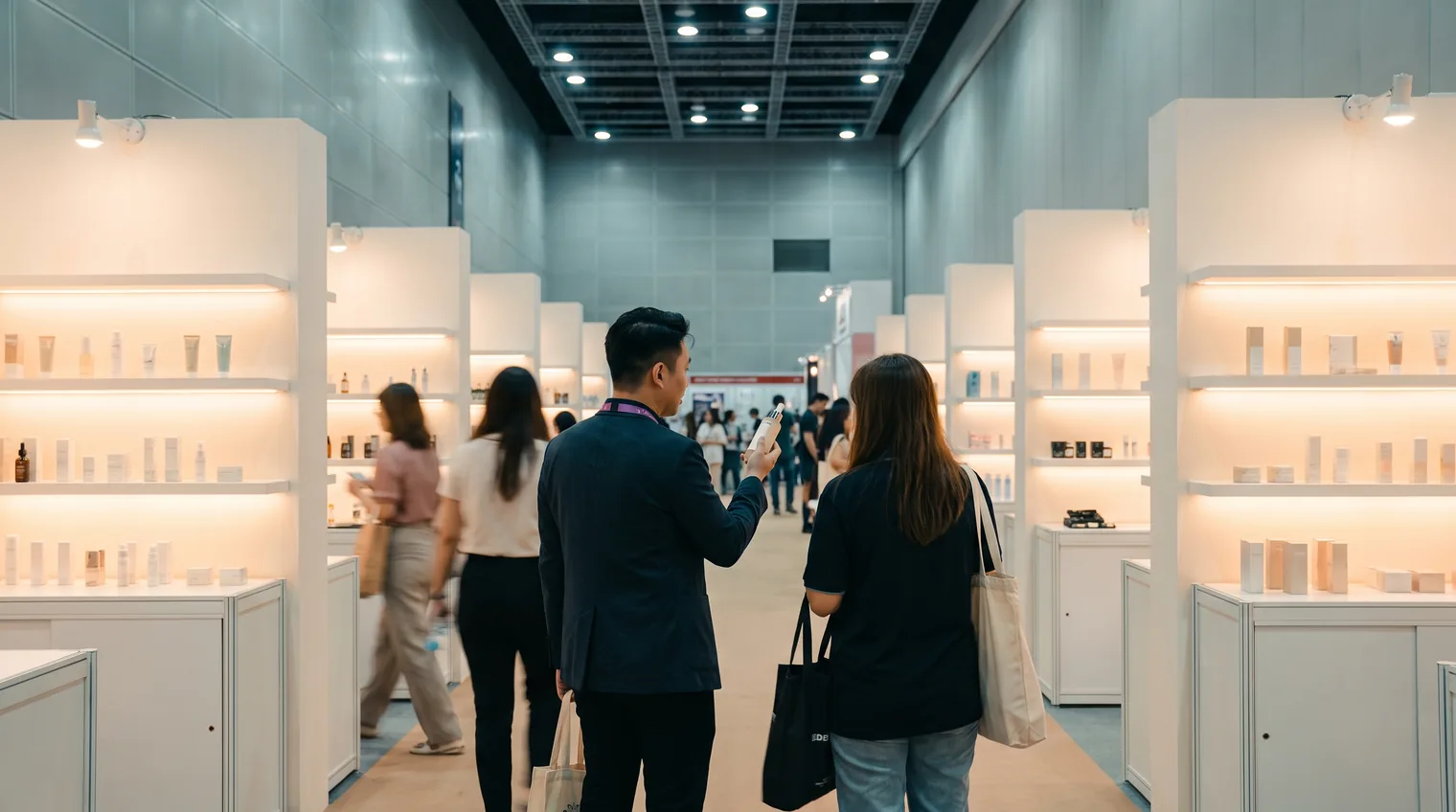
From 29 September to 1 October I spent three days at Cosmobeauté Malaysia and beautyexpo at the Kuala Lumpur Convention Centre. The organisers put it at around 400 exhibitors and 1,000 brands from 15 countries and regions, with international pavilions from China, Korea, Singapore and Taiwan, and a dedicated halal beauty zone.1 On the floor it felt like three groups: Malaysian brands, a large contingent of Taiwanese and Korean brands, and Chinese contract manufacturers looking for brands to make products for.
I went to listen. Most of the overseas exhibitors I spoke to had the same question in different words: how do we actually get into this market, and once we are in, how do we get Malaysians to buy?
Why Malaysia is harder than it looks from Taiwan
The most honest answer came from a Taiwanese brand owner, and it stayed with me. Staff and material costs in Taiwan are high, so they cannot win on price against mainland China. On brand power, packaging and the ability to excite a consumer, they feel they cannot win against Korea. And their network and perspective are built around the home market, so when they reach for a new customer overseas, they run into a culture they do not yet understand.
That is a squeeze many mid-sized Asian brands are in. Malaysia looks like a natural next step: Chinese Malaysians share a lot of the cultural reference points, English is widely used, and online shopping is a habit. But Malaysia is three audiences at once, Malay, Chinese and Indian, in three languages, with a Muslim majority and a festive calendar that runs all year. A brand that is neither the cheapest nor the most desired has to become the most relevant, and relevance is local.
Step 1: nothing sells without a local notification holder

Malaysia regulates cosmetics under the Control of Drugs and Cosmetics Regulations 1984, through the National Pharmaceutical Regulatory Agency (NPRA) of the Ministry of Health (KKM). The notification system follows the ASEAN Cosmetic Directive.7 The rules are clear and they apply to every overseas brand:
- It is an offence to manufacture, import or sell a cosmetic product in Malaysia unless it has been notified first.7
- The notification must be held by a company registered in Malaysia, known as the cosmetic notification holder. A foreign company has to appoint a local agent to be the holder, and give it a letter of authorisation if the agent does not own the product.2
- The processing fee is RM50 for each product and each variant. A notification is valid for 2 years and must be renewed no later than 1 month before it expires.2
- Labels must be in Bahasa Malaysia, English, or both.3
The fee is small. The real work is having the formula, safety assessment, claims and product information file ready, and having a local holder you trust, because that company carries the product's regulatory responsibility in Malaysia.
Step 2: distributor, your own entity, or both
Most overseas brands at the show wanted the simplest route: find a distributor. It is a common first step for exporters to Malaysia,4 and for good reason. A distributor can hold the notification, import, warehouse and open retail doors.
The catch is that a distributor's strength is moving stock, not building a brand. Many brands sign one, ship a container, and discover a year later that the product is listed online but nobody is working the listings, making content, or reading the data. The options look like this:
| Route | What it solves | What it usually leaves open |
|---|---|---|
| Distributor only | Notification, import, stock, retail access | Who runs the online stores and the content, and who owns the customer data |
| Your own Malaysian company | Full control, and you can hold the notification yourself | A local team for operation, content and service, which takes time and money to build |
| Distributor or own entity, plus an e-commerce partner | Regulation and stock handled locally, and the selling run by specialists | A clear handover between the parties, which has to be agreed upfront |
Step 3: import it, or have it made in the region
The second question that came up again and again was supply. One path is to import the finished product from home. It keeps the formula and the made-in-Taiwan or made-in-Korea story intact, but it carries home-market costs into a price-sensitive market.
The other path is to work with a contract manufacturer in Malaysia or elsewhere in Southeast Asia, often under an NDA and using the manufacturer's own formula, to cut labour and material costs and make the price more competitive with a better margin. That is a real option, and plenty of the manufacturers at the show were there to offer exactly that. The trade-off is that the product's difference no longer comes from the formula. It has to come from the brand, the positioning and the content, which is the part foreign brands told me they find hardest.
Step 4: decide on halal before you print the packaging
Halal is not legally required to sell a cosmetic in Malaysia, but you cannot simply declare a product halal either. Under the Trade Descriptions (Certification and Marking of Halal) Order 2011, self-declared halal claims are not allowed. A product described as halal has to be certified, with JAKIM as the competent authority and MS 2634:2019 as the standard for halal cosmetics.5 For an imported product, NPRA accepts a halal logo certified by JAKIM or by a foreign Islamic body that JAKIM recognises.7 Taiwan and Korea each have two bodies on JAKIM's current list, so check that yours is on it before you print.8 Anyone can check a product's status with the Verify Halal Status search on JAKIM's Halal Malaysia portal.6
For a brand that wants to reach Malay Muslim consumers, halal is a commercial decision more than a legal one, and it affects the formula, the supplier and the label. Make it early. Retrofitting halal after the packaging is printed is the expensive way to do it.
If you are the manufacturer: what Malaysian brands will ask you
The contract manufacturers at the show have a different problem. Their customers are brands, and a Malaysian brand switching suppliers will test three things:
- Do you understand this market? Halal certification for the Malay market is the obvious example, and a manufacturer that cannot speak to it will lose the conversation early.
- Are you different enough to replace a local supplier? Being a little cheaper or a little better rarely justifies the risk of switching.
- Is your price competitive, and is there proof it sells here? A formula that has already performed in Malaysia, or a market very like it, is worth more than a catalogue.
The part most entry plans leave out: who sells it after it lands
Every conversation I had at the show eventually arrived at the same place. Notification, distribution, supply and halal get the product into the country. None of them gets a Malaysian to pick it over the brand they already know.
Beauty in Malaysia is bought and discovered online, on Shopee, Lazada and TikTok Shop, and through short video. That is where a foreign brand either becomes relevant or stays invisible, and it is where the culture gap the Taiwanese brand owner described actually bites. Content made for Taiwan or Korea does not land the same way here. It has to be made in Bahasa Malaysia, English and Chinese, around the festivals and trends Malaysians are actually living through.
That is the stage we run. Once the product is cleared to sell, foreign brands can hand us two things completely: running the Shopee, Lazada and TikTok Shop stores, and producing the short video for the brand's own channels, in all three languages. The distributor moves the stock. We make sure Malaysians want it.

What struck me most was how many good products were standing in that hall with no plan for the day after they land. Brands spend months on the notification and the distributor contract, then expect the market to take it from there.
A brand that cannot win on price or on hype has one way in: being more relevant to the Malaysian customer than anyone else. That is not something you can do from Taiwan or Korea. It has to be done here, every day, in the customer's language.
A launch sequence that works
- Pick the hero. Start with a few products around one clear customer problem, not the whole range.
- Appoint the local holder. Agree who holds the NPRA notification and who imports.
- Choose the supply route. Import, or manufacture in the region, with the cost and differentiation trade-off understood.
- Make the halal call. Before formula and packaging are final.
- Localise the label and the claims. Bahasa Malaysia or English on pack, and claims that stay within cosmetic scope.
- Launch online, with local content. Shopee, Lazada and TikTok Shop, supported by short video made for Malaysians.
- Take the data to retail. Once the hero product sells online, physical retail becomes a much easier conversation.
If you have been asked to find partners for Malaysia
If you are the person tasked with making this happen, map who owns each piece before you sign anything. The gaps between partners are where launches stall.
| Ask this | Why it matters |
|---|---|
| 1. Who holds our NPRA notification? | It must be a Malaysian-registered company, and it carries the regulatory responsibility. |
| 2. Who imports, stores and ships the stock? | Late shipping is penalised on every marketplace, so this has to be reliable from day one. |
| 3. Who runs Shopee, Lazada and TikTok Shop? | Listing the product is not the same as operating the store. |
| 4. Who makes content in Bahasa Malaysia, English and Chinese? | Translated content from home rarely lands with Malaysian buyers. |
| 5. Who owns the store accounts and the customer data? | The brand should, whoever operates them. |
| 6. How do these partners hand over to each other? | Stock, campaigns and content have to move on the same calendar. |
If rows 3 and 4 are still empty, talk to us on WhatsApp. We will tell you honestly how we would approach your launch, and which other partners you will need around us.
- Every cosmetic must be notified to the NPRA before it is manufactured or imported, and only a Malaysian-registered company can hold the notification.
- The fee is RM50 per product or variant, valid for 2 years. Labels must be in Bahasa Malaysia and/or English.
- A distributor solves import and retail access. It rarely builds the brand online.
- Manufacturing in the region can cut cost, but the product's difference then has to come from brand and content.
- Halal is optional, but self-declared halal is not allowed. Decide before packaging.
- The last stage, selling on Shopee, Lazada and TikTok Shop with local content, decides whether the launch works.
Quick answers
How do I register a cosmetic product in Malaysia?
Do cosmetics need KKM approval in Malaysia?
Can a foreign company hold an NPRA cosmetic notification?
How much does NPRA cosmetic notification cost?
Do cosmetics need halal certification in Malaysia?
How can I check if a product is halal certified in Malaysia?
Should a foreign beauty brand use a distributor in Malaysia?
What language must cosmetic labels be in for Malaysia?
Sources & further reading
- PR Newswire: Cosmobeauté Malaysia & beautyexpo 2026 opens at KLCC
- NPRA: Frequently asked questions (cosmetics)
- NPRA: Guidelines for Control of Cosmetic Products, Annex I Part 7, Cosmetic Labelling Requirements
- International Trade Administration: Malaysia market entry strategy
- ChemLinked: Interview with JAKIM on Malaysia's halal certification for cosmetics
- JAKIM: Halal Malaysia portal, Verify Halal Status
- NPRA: Guidelines for Control of Cosmetic Products in Malaysia (second edition, 2022)
- JAKIM: Recognised foreign halal certification bodies (effective 21 August 2026)
Regulatory requirements change. Confirm current NPRA and JAKIM requirements with your notification holder or a regulatory adviser before launch. The market observations come from conversations at Cosmobeauté Malaysia 2026 and Hansen's own work with brands in Malaysia.
Bringing your brand to Malaysia?
Once your product is cleared to sell, we run the Shopee, Lazada and TikTok Shop stores and produce the short video that makes Malaysians want it, in Bahasa Malaysia, English and Chinese.