AI vs agency vs in-house: what short video really costs to produce in Malaysia
There are three ways to make short video: in-house, agency, and AI-assisted. The honest comparison isn't about which is 'cheapest'. In-house isn't cheap once you count the crew and the time; an agency buys polish at a premium but not volume; AI-assisted, done under professional planning, is the one route that delivers quality and the sustained quantity the algorithm demands. Think efficiency and stability, not price.
"How much should a TikTok video cost?" is one of the most common questions we get, and it's the wrong question to lead with. The useful one is: which approach gets you content that's good enough, in the quantity you need, reliably? There are three ways to make short video, and they differ far more in that than in any headline price.
The three ways to make short video
- In-house. You build a team and shoot it yourselves. People assume this is the cheap option. It usually isn't, as the hours below show.
- Agency / production house. You brief a team that handles concept, shoot, talent and edit. You buy real polish and offload the work, at a premium, and rarely at volume.
- AI-assisted. You use AI tools for the visual production under human direction. Done properly, it's the route that holds quality and keeps the volume flowing, steadily and on schedule.
Why in-house is rarely the cheap option
The instinct is that doing it yourself saves money. So picture what "doing it yourself" actually needs to hit a decent standard:
- Two on-camera talents;
- Someone to shoot;
- Someone to edit;
- Often a stylist or wardrobe person too;
- Plus props, a location or studio to rent, and post-production.
Add those up and "in-house" stops looking cheap. And there's a second cost that never makes the budget: stability. People get sick, have off days, or leave, and every wobble hits your quality and your posting schedule. Human production is necessary and valuable, but it isn't free, and it isn't reliably repeatable at volume.
The hours nobody puts in the budget
Ask a brand what a video costs and they will tell you about equipment. Ask them how many hours it took and the conversation gets quieter.
In our experience a team producing their own short video spends somewhere between 8 and 20 hours a week on it, and the range is wide because it depends on how much gets redone. The work is not the filming. The work is everything around the filming:
- Coming up with the concept, and researching what competitors and the wider feed are doing;
- Preparing the product, props and setting;
- Writing the script;
- Getting the right people in the same place at the same time;
- Shooting, which never goes right on the first take;
- Editing;
- Re-shooting whatever was missed and only became obvious during the edit;
- Colour, sound, captions and the final polish.
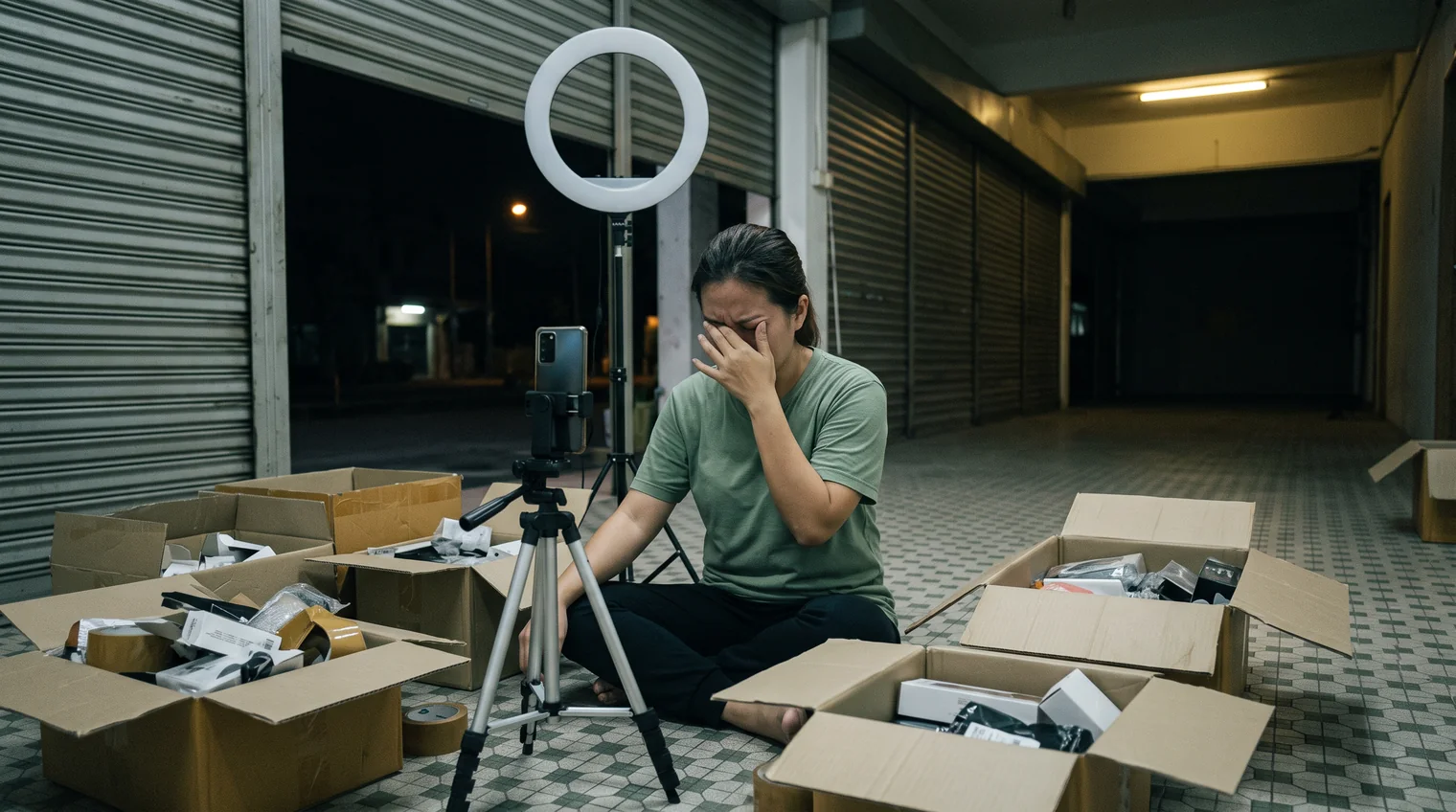
This is why in-house teams so often settle at roughly one video a week and then wonder why the account never gains momentum. The bottleneck is not skill or equipment. It is that one person is doing this alongside their actual job, and the pre-production alone eats the week.
The honest way to price in-house is to take those hours, multiply by what that person's time is worth to the business, and compare that against the alternatives below. Most brands have never run that calculation.
What the market actually charges in Malaysia
Published 2026 rates give you a reference point before anyone quotes you.
| What you are buying | Typical price |
|---|---|
| Video editing, hourly | RM0 to RM300+ per hour depending on whether it is AI tools, a freelancer or an agency[1] |
| Single basic short-form clip, edited | RM300 to RM800[1] |
| Series of 3 to 5 clips, heavier editing | RM1,500 to RM4,000[1] |
| Social media video, produced by a production house | RM1,000 to RM5,000 per video[2] |
| Agency retainer for social content | From RM3,000 per month[1] |
| High-end commercial production | RM50,000 to RM150,000+[1] |
Notice what most of those rates are priced against: a piece of work. Traditional production charges per shoot, so your tenth video costs roughly what the first one did, and the planning question quietly becomes how few videos you can get away with. That is the constraint worth escaping. AI-assisted production concentrates the work in creative direction instead, so the number of videos stops being the thing that decides what your brand can attempt in a year.
The budget line worth re-examining first
Before deciding how to fund content, it is worth looking at what the money is currently doing.
A pattern we see constantly in Malaysia is heavy spending on traditional advertising out of habit. Television, print, roadside billboards. A billboard placement can run to RM50,000 for three to six months, and the case for it is footfall. But footfall is not conversion. Of the people who drive past, how many register the brand, and how many could you name afterwards? The spend is hard to attribute and harder to improve, because there is no feedback loop to learn from.
None of that makes it wrong. If the budget is genuinely large, brand-awareness media has a role. For most small and medium businesses, though, the return per ringgit is poor compared to what the same money does in a channel you can measure.
Where budget is limited, our recommendation is to split the work by who is irreplaceable.
Keep your own time and money on product quality, customer service and your private channels. That includes the content only you can create: the founder on camera explaining why the product exists, footage from inside your own factory, live events, the honest use-case story. Nobody can outsource that authentically, and it is what turns attention into trust.
Then hand the public-facing volume to someone whose whole job is producing it consistently. That is the part that has to happen every week whether or not you had a good month, and it is the part that quietly does not happen when a founder is busy.
The combination is what makes it work. A consumer scrolling sees consistent, well-made brand content, and when they look closer they also find the real person, the real premises and the real operation behind it. One provides reach, the other provides belief. There is more on how those pieces become durable in why your videos are assets, not posts.
| Approach | Quality | Quantity & speed | Stability | Best for |
|---|---|---|---|---|
| In-house | Good these days | Low, hard to sustain | Variable, with people, moods and turnover | Authentic founder content, occasional pieces |
| Agency | Very high, polished | Low & scheduled | High per project | Hero films, launches, brand-image pieces |
| AI-assisted (planned well) | High | High, sustained and on schedule | High, consistent output | Always-on brand presence at quality volume |
Audiences are meeting AI halfway
Worth saying plainly: viewers are increasingly comfortable with AI-made content, the same way audiences grew comfortable with animation or any other visual style. It's becoming a familiar, accepted type, not a red flag. Some people still won't love it, just as some people don't enjoy cartoons, and that's fine. You're not trying to make every single viewer love it; you're building a brand the right people trust. (We dig into that craft in making AI video that doesn't look like AI.)
The real balance: quality and quantity
This is where the three approaches truly separate:
- In-house and agency content is usually good quality these days, but rarely reaches the quantity the platforms reward.
- Most cheap AI content does the opposite: plenty of quantity, but crude and careless.
Running a brand properly means refusing that trade-off, holding quality while sustaining the volume of output the algorithm needs. That combination is what pulls in new customers and keeps existing ones warm, and it's the whole point of our AI content service, The Aesthetic: it sets the brand's tonality and the way people and products are shown, and it keeps the output stable, in quality and on time.

I don't want anyone walking away thinking of this as the "cheap" option, because that word drags two wrong ideas with it: that the quality must be poor, and that you can just churn it out. Neither is true. Producing content that's genuinely good and in real quantity isn't cheap; it's more efficient, reaching the result with a better use of time and money than the old way, and that edge only grows.
But that only holds under proper planning. It comes from experienced hands directing the tool, not the tool on its own. And I'm not against real filming: for a brand with budget, put some into professional human production and some into stable, high-quality AI content. If budget's tight, lock in the steady quality flow first, then fund the human shoots from what it earns.
The smart mix: AI content and human film together
We don't pretend AI replaces professional human production. For a brand with the budget, the sensible split is both:
- Part of the budget to real, professional human filming, for the occasional hero or brand-image piece;
- Part to stable, continuous, high-quality AI content that keeps the brand present every day.
Together they build a stronger, more memorable brand than either alone. And if budget is tight, the priority is clear: secure the stable, quality content flow first, then, once it's working and earning, put some of the returns toward a few human-shot films. You can see how we run the AI side on our AI short video page.
- Don't ask which is cheapest. Ask which delivers quality at the quantity you need, reliably.
- In-house isn't cheap once you count crew, props, venue and editing, plus 8 to 20 hours a week of someone's time.
- The real trade-off: in-house and agency give quality but not quantity; careless AI gives quantity but not quality. Hold both.
- AI-assisted, planned well, is efficient rather than cheap, and audiences increasingly accept it.
- With budget, run human film + stable AI content together; if tight, secure the quality flow first.
Quick answers
How much does it cost to produce a TikTok video in Malaysia?
How many hours does in-house video actually take?
Is AI-assisted video as good as an agency shoot?
Does AI content mean lower quality?
Sources & further reading
Need more content, faster, without blowing the budget?
On a free 30-minute call we'll map the most efficient way to hit your content volume at quality — and show you what AI-assisted production can and can't do. No commitment, no pitch deck.