Which products suit AI video, and which still need a real person
Two things decide it: how much trust the purchase requires, and how much the product depends on being seen or felt. Plot your category on those two axes and the format picks itself. Low trust threshold means AI content can lead. High trust threshold means a real person still has to appear somewhere.
Every week someone asks whether AI video will work for their product. The honest answer is that technically it will work for almost anything. That is not the useful question.
The useful question is whether AI content should be the lead format for your category, or a supporting one. Get that wrong and you either burn money filming things that did not need a human, or you put a synthetic face in front of a purchase decision that was never going to be made on a synthetic face.
The two axes that actually matter
We plot categories on a simple grid before recommending anything.
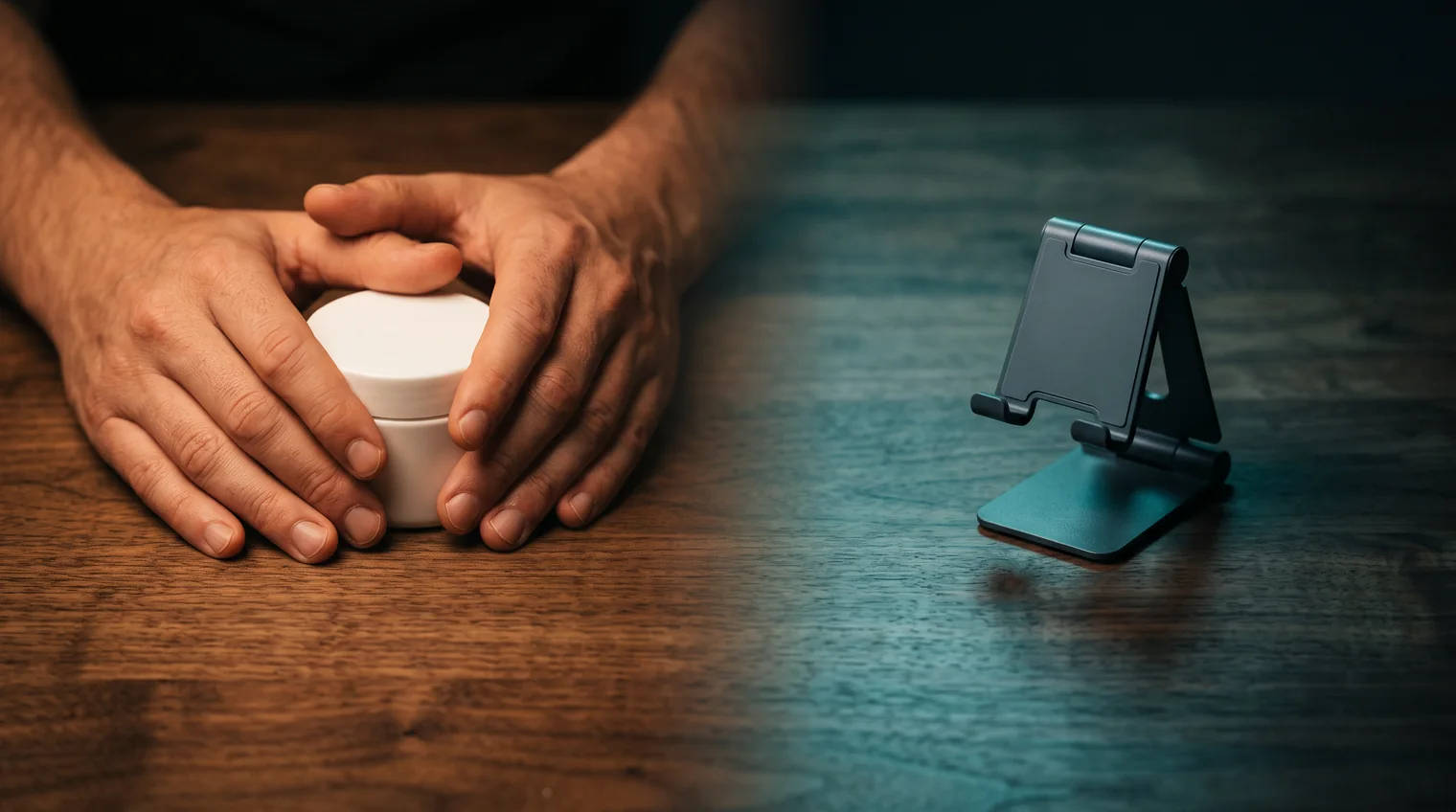
The vertical axis is the trust threshold. How much reassurance does someone need before they hand over money? A phone holder needs almost none. A supplement your child will swallow needs a great deal. This is about perceived risk, not price, although the two often move together.
The horizontal axis is experience intensity. How much does the purchase depend on seeing, feeling or sensing the thing? Some products sell on specification and price alone. Others need visual impact before anyone cares.
| Zone | Position | Typical categories | Lead format |
|---|---|---|---|
| 1. Blended | High trust, high experience | High-price custom products, paid knowledge, premium consulting, brand films | Real human for trust, AI for volume |
| 2. Real UGC | High trust, low experience | Skincare and beauty, baby and maternity, supplements, higher-priced apparel | Real person leads, AI supports |
| 3. Automation | Low trust, low experience | Phone and computer accessories, kitchen and home gadgets, household goods, simple software | Faceless AI, best fit |
| 4. Visual | Low trust, high experience | Home decor, feature lighting, outdoor gear, 3D display | Faceless AI with strong visual production |
Where a real person is not optional
Two situations override everything above.
The first is personal brand content. If the product is you, or your reputation is the reason people buy, there is no synthetic substitute. That is the whole asset.
The second is the trust moment between an owner and a customer. For anything that goes on skin, into a body, or near a baby, buyers want to see the people behind it. If you sell food that goes straight into someone's mouth, show your factory and how it runs. Show the founder explaining why the product exists. You do not need to film every day for this. You need to film the right moments.
Independent guidance lands in the same place. Reviews of no-filming production routes flag supplements and wellness products with health claims, apparel and footwear, and high-consideration electronics as the categories where creators who can lend a face and credibility are worth more than tools that produce faceless videos faster.[1]
The line is moving, and it moves one way
I want to be clear that this matrix is a snapshot of 2026, not a permanent law.
The reason certain categories still need a human is not that AI cannot render them. It is that audiences are still forming a trust relationship with synthetic content. That acceptance is rising, and everything we see says it keeps rising. Zones will shift downward and leftward over the next few years as viewers stop caring how a video was made and start caring only whether it was worth watching. We plan for that rather than against it. The related argument is in how to make AI video that doesn't look like AI.
How we actually make the call
The matrix is step one of four.
- Place the product on the grid. Does this purchase genuinely need human reassurance and emotional resonance, or does it need someone to show clearly that the thing works?
- Check whether the arithmetic survives. If a product sells at RM10 to RM20 and each KOL-produced clip costs RM200 to RM500, volume kills the return before you start. Deeper productions run from the low thousands into far more per video. Where the unit price is thin and the volume requirement is high, AI-assisted production is often the only route where the numbers work at all.
- Test for seven days to a month. Over a month we produce a batch, put a small ad budget behind selected videos, and watch three-second retention and interaction rate. For products with a natural repeat cycle we also watch repurchase behaviour.
- Cut and scale. Weak formats get dropped. The formats that held attention get reproduced at volume and written into the standard operating procedure so the next batch starts from what already worked.
What this means if you are choosing right now
If you sell functional products where a demonstration closes the sale, AI-assisted content can carry your daily presence and you should start there. If you sell into a high-trust category, plan for a hybrid: reserve real filming for the founder, the process and the campaign moments, and let AI production handle product demonstration, scenario content and UGC-style pieces in between.
What almost never works is choosing based on which one is cheaper.
Quick answers
Which products suit AI-generated short video best?
Which products still need a real person?
Can I use both AI video and real filming?
How do I know if AI video makes financial sense?
Sources & further reading
Not sure which zone you are in?
Tell us what you sell and we will place it on the grid with you on a free 30-minute call. If the answer is that you need a real person, we will say so.